
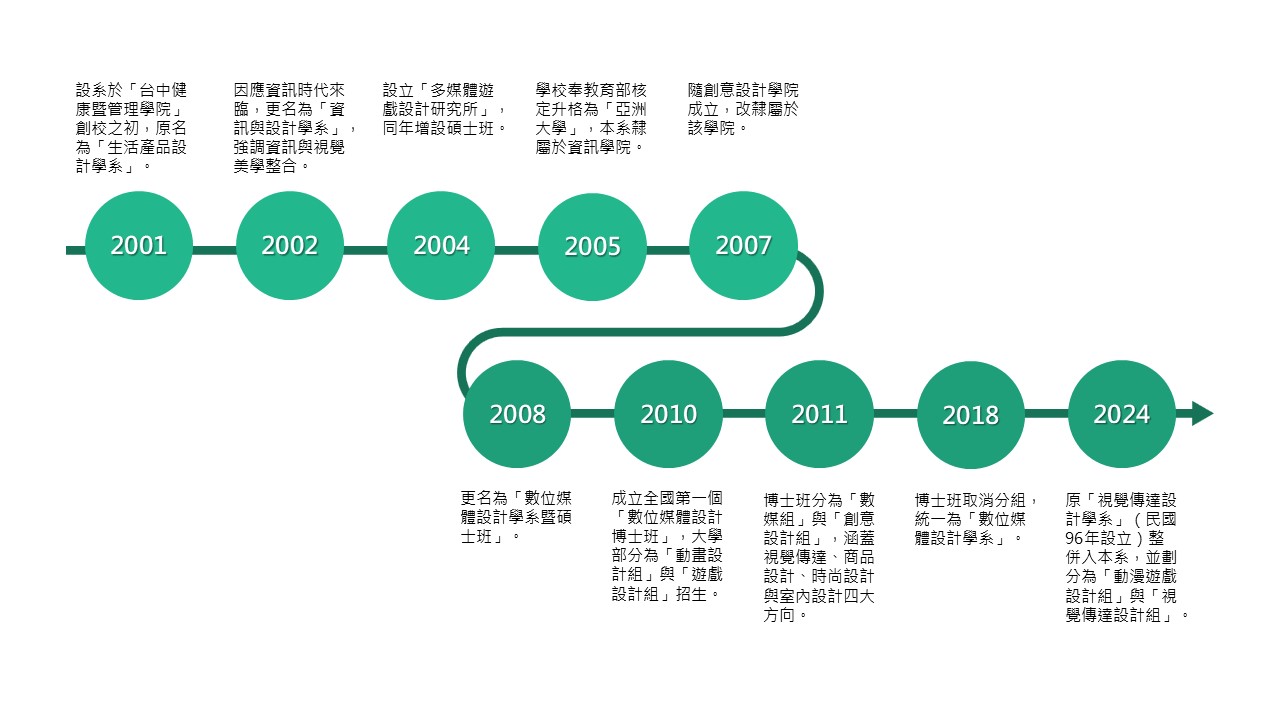
The Department of Digital Media Design at Asia University was founded in 2001 under what was then Taichung Healthcare and Management University. It was initially named the "Department of Lifestyle Product Design." The following year, in response to the development of the digital age, it was renamed the "Department of Information and Design," and gradually expanded its teaching scale and research areas.
As the university was officially upgraded to "Asia University" in 2005, the department continued to improve. In 2007 it was transferred to the newly established College of Creative Design, and in 2008 it was renamed the "Department of Digital Media Design and Master's Program," becoming one of the earliest departments in Taiwan devoted to digital media teaching and research.
In 2010, it was approved by the Ministry of Education to establish Taiwan's first "Doctoral Program in Digital Media Design," and in 2011 the doctoral program was further divided into the "Digital Media Track" and the "Creative Design Track," which covers diverse design fields.
To strengthen the integration of teaching and research and optimize resources, the former "Department of Visual Communication Design" was merged into this department in 2024.
Starting from Academic Year 115, the department admits students without dividing them into tracks, emphasizing interdisciplinary integration and innovative practice, and is committed to cultivating digital creative talents with both design aesthetics and technological capability.
The department focuses on the interdisciplinary integration of digital media and visual communication design, covering core areas such as digital animation, game design, interactive simulation, digital art, brand marketing, and visual aesthetics.
The curriculum combines digital technology with creative design, emphasizes the integration of technological application and humanistic literacy, and provides students with hands-on experience from 2D graphics to 3D interaction, cultivating professionals with innovative thinking and practical ability.
Through project work, industry-academia collaboration, and international exchange, students can build connections among design, technology, and culture, and develop globally competitive digital design skills.